
Most homeowners have never heard of a float switch until the day their air conditioner shuts off on its own. Then it becomes the most important part in the house.
Here’s what it is, why it matters more in a coastal climate than almost anywhere else, and what to do when yours trips.
What a float switch actually does
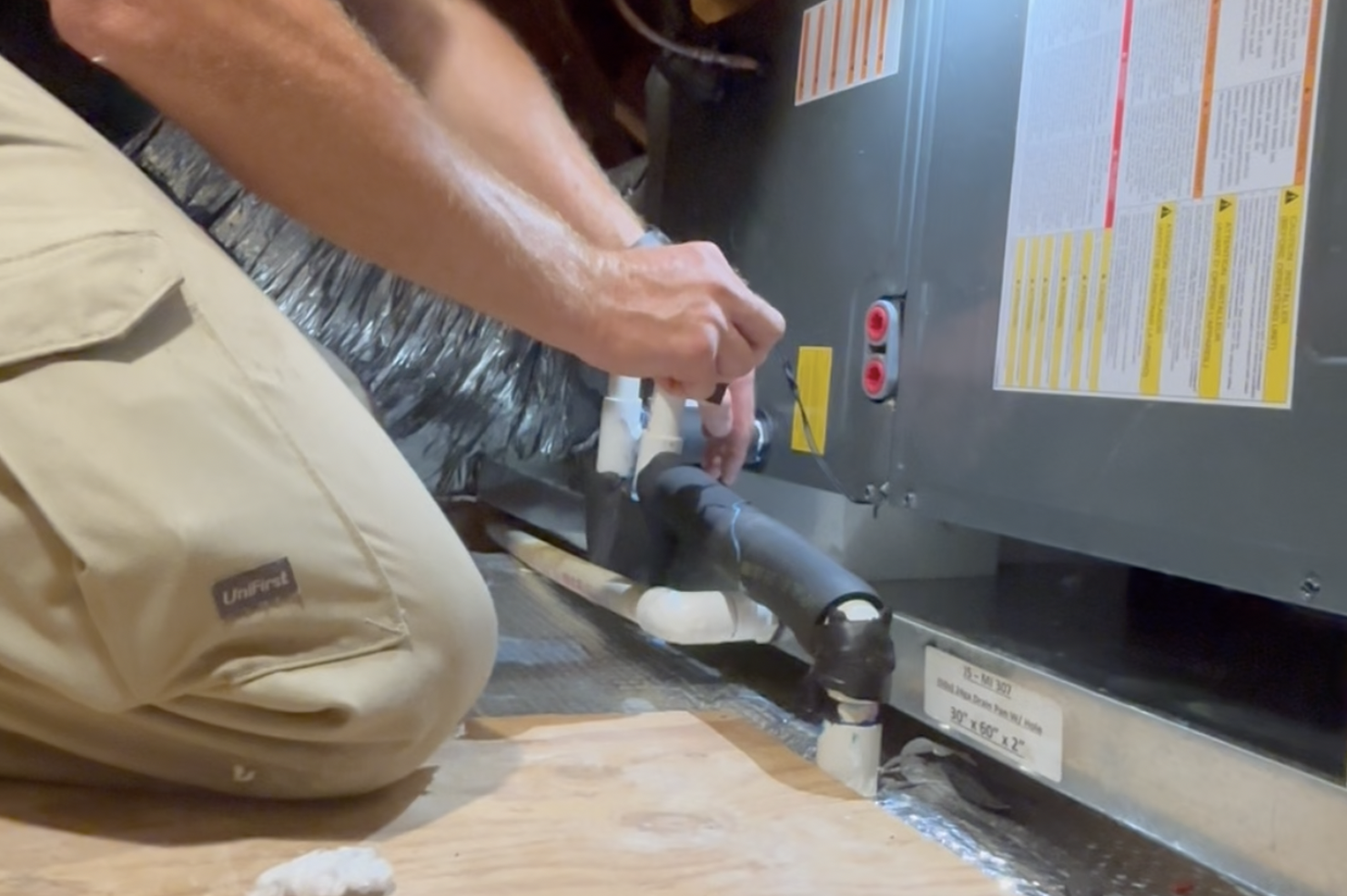
Your air conditioner doesn’t just cool air. It pulls moisture out of it — a lot of moisture. That water condenses on the evaporator coil, drips into a drain pan, and runs out of your house through a condensate drain line.
On a humid day along the Grand Strand, a residential system can pull several gallons of water out of the air. That water has to go somewhere every single hour the unit runs.
The drain line is a narrow PVC pipe, usually under an inch across, and it lives in a warm, wet, dark environment. That is close to ideal conditions for algae and biological sludge. Over time, the line clogs.
When it clogs, the water has nowhere to go. The pan fills. And then the water finds its own exit — through the bottom of the air handler, through the attic floor, and through your ceiling.
A float switch is the safety device that stops that from happening. It’s a small sensor mounted in the drain pan or plumbed into the drain line, holding a float on a pivot. When the water level rises past a set point, the float rises with it, opens an electrical circuit, and shuts the system off.
No cooling is annoying. A collapsed ceiling is a five-figure problem. The switch chooses the first one for you.
Why this matters more here
Attic air handlers and coastal humidity are a bad combination, and the Grand Strand has both in abundance.
When the air handler sits in the attic, gravity is working against you. Every gallon that escapes the pan travels straight down into the living space below. A first-floor closet unit that overflows makes a mess on the floor. An attic unit that overflows ruins drywall, insulation, lighting, and whatever is sitting on the furniture underneath.
Add humidity that runs high from roughly May through September, and a system that runs nearly continuously for months, and the drain line here is moving far more water than the same unit would in a drier climate. More water through the line means faster algae growth and more frequent clogs.
How to tell your float switch has tripped
The symptoms look like a system failure, which is why most people call about the wrong problem.
The AC shuts off and won’t restart. The thermostat has power and the display looks normal, but nothing happens when the system calls for cooling. No outdoor unit, no blower.
The system runs but doesn’t cool. Depending on how the switch is wired, some setups cut only the outdoor condenser. The indoor blower keeps running, so you get airflow at the vents — just not cold airflow.
It starts working again on its own, then quits again. Water drains down slowly, the float drops, the system restarts, the pan refills. A system that cycles like this over a few days is telling you the drain is partially blocked.
Water where water shouldn’t be. A stain on the ceiling under the attic unit, standing water in the pan, or dampness around the air handler means the switch either failed or was never installed.
A musty smell from the vents. Standing water in a pan grows biological material. If the air coming out of your vents smells like a basement, the drain system is a good place to start looking.
What to do when it trips
First, understand what happened: the switch didn’t break. It worked. Something upstream of it went wrong, and the switch caught it.
Don’t bypass it. This is the single most important thing in this article. There are instructions online for jumping the switch to get the AC running again. Doing that removes the only thing standing between a clogged drain and your ceiling, and it converts a service call into a water damage claim. If someone tells you to bypass a float switch to restore cooling, find someone else.
Check for standing water. If you can safely see the drain pan, look. Water in the pan confirms a drain problem rather than a faulty switch.
Turn the system off at the thermostat. Running it while the pan is full only adds more water.
Call for service. Clearing a condensate line properly means finding the blockage, clearing the full run rather than just the visible end, flushing the line, checking the pan and trap, and verifying the switch actually functions afterward. A shop vac on the outside end sometimes moves a clog, but it doesn’t tell you whether the line is clear along its whole length or whether the switch is working.
The part most homes are missing
Here’s the uncomfortable part. Float switches are not universally installed. Plenty of systems — particularly older ones, and plenty of builder installations — have no secondary drain protection at all.
If your air handler is in an attic and you have never heard anyone mention a float switch, there is a reasonable chance you don’t have one.
It’s an inexpensive part and a short installation. Set against what water damage to a ceiling costs to repair, it is among the easiest decisions in home maintenance.
Prevention beats repair
Drain line problems are among the most preventable HVAC failures there are. A condensate line that gets flushed as part of routine maintenance rarely clogs badly enough to trip anything.
A seasonal tune-up should include clearing and flushing the condensate line, inspecting the pan and trap, and testing the float switch to confirm it will actually shut the system down when it needs to. If your maintenance visit hasn’t included that, ask why.
Not sure whether your system has a float switch — or whether it works?
Our technicians check the condensate drain and safety switch on every service visit, and we can install one if your system doesn’t have it. Call At Your Service Plumbing, Heating & Air at 843-325-0135.